First, I'd like to make known that I understand very little mandarin, and my experiences with music in the language has more to do with matters that tugs my heartstrings.


For me on a personal note, this has gotta be Lily Chen's best album by far. I've got quite a few, if not all of her albums. I've got the lucky break to meet her in person at one of the KLIAV Shows and she's a re...al looker too, in typical china men preference for fair unblemished skin toned, slender yet subtly curvy and finally that killer shampoo advertisement quality long, shinny black hair stereo type! After that fateful day, many of my hifi friends became a true fans of Lily.


Now back to this album, which songs are based on works of the lovely poetry writer Li Qing Zhou, a lady whom lived in the times of Song Dynasty China. While some of the tunes here were previously covered by the "great" Teresa Teng, I felt that it will always be risky to be directly compared to Teresa. In this case, it did Lily no favours either.


What really struck me was the rest of the presumably still yet covered songs which the arrangement of fusing Chinese and Western classical instruments to form a fusion of rich classical style timbre and pop influenced harmonies. Most songs deals with the subject to love, requited or otherwise, and a sentiment of mom's presence plus the longing of that tranquil fishing village. Remember, this was the Song Dynasty China, not today. This album touches the heart strings superbly, reminiscent of the gentler days of ol' China folks.


While Lily's singing is technically pitch perfect, but over time, I felt she has a tendency to slip in to a rather mechanical rendition of songs. NOT this time though. I guess she just managed to get in to the material as much as I got in to her renditions of it. Recording wise, it's standard Rain Forest Studio DSD clarity, good portrayal of the classical instrument's warm tonal qualities, with sometimes sibilance accompanying vocal.


Just like the Jennifer Warnes Famous Blue Raincoat, which takes from the poetry of Leonard Cohen, I find them both comparable in style and execution, with the Jennifer Warnes work having a more polished presentation overall.


Well, may be I do like poetry in song after all?


[In-Line Advertisements]


It's been a while since we talked about music, after all the ultimate aim of assembling a top notch hifi system is to enjoy music, presented in it's full glory, in the comforts of your own home, anytime at your convenience.

So I'd like to share my own all time favorites of 10 desert island disc, as maggielurva would call it. You'd notice that none are recently released, and re-releases don't count either. For me desert island disc must be the one's that have withstood the test of time. Meaning it should be in your collection for a while at least, and you still have the urge to listen to them every now and then.

See any familiar favorites on top?

I'll do one a day until all 10 disc are accounted for.

First one starting tomorrow.


[In-Line Advertisements]


The outside, nothing has been changed.


Many thanks to GCK and a few others whom pointed out some missing elements in my home brew Kable Kooker. Chief amongst those is the variable frequency sine sweep function, which unfortunately, came to a point where a DIYer like me has to call it a day. After all, certain things are just beyond my grasp and abilities.

The inside, note the white 5W rated loading resistors.


I went to the Audio Dharma website, where there's plenty of information on how the real thing worked. It than dawned on me that I had made two mistakes in my earlier attempt. The mistake was that I had used the standard XLR/RCA cable spec impedance to load the cables as it cooks. As per explained clearly by Alan Krafton on the Audio Dharma website, I should 've used a power amp's load to cook the XLR/RCA interconnects instead. A quick consult on my Pass Aleph 0 manual indicates the amp's load to be 25k ohms for XLR and 10k ohms for RCA. Further consultation with my senior DIYer sifu tells me that some tube power amps can present loads as much as 47k ohms for XLR and 20k ohms for RCA interconnects. Just to be sure, I used the bigger values for a more effective cook.

Another view of all the loading resistors for XLR, RCA and speaker cable cooking. The top 2 resistors for XLR loading value 47k ohms @ 5W.


As my previous load resistors for the XLR and RCA are rated 2W, I've found them to run moderately warm when cable cooking. To increase reliability and lifespan, I used 5W rated resistors this time. Similarly, my home brew kable kooker also measured up to 1.86 amperes when cooking speaker cables, against the original measuring 1.88 amperes. That means I was right on the $$$ where speaker cable cooking is concern.

The RCA(at bottom) load resistor value 20k ohms @5W.

Just to try, for my self, I re-cooked my AQ Sky and Colorado XLR interconnects again, and found the results of the cooked cable much more sonically satisfying at shorten cooking time. To get the same level of results, I used to have to cook about 96 hours, or 4 days. Now I can do so with the same great results in 24 hours!

Now that's what I mean efficient cooking!

Once again, thanks for sharing your "desirable thoughts" with me. I've learnt so much from your kind responses.


[In-Line Advertisements]


1st owner, with box and full accessories. condition: 8.5/10

call 012-2083790.


[In-Line Advertisements]


The system with WVIP(Wilkin's Very Important Princess!)

I have been a great fan of open baffle speakers for many years now. I like the way they present a huge soundstage with very spacious and lively feel. I'll never miss a chance to hear a pair of these, if I know they exist and owner is willing and game to share!

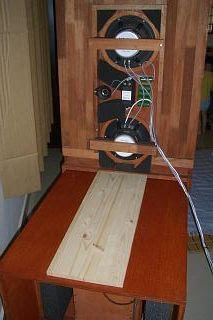
The hand made speaker, note the AMT ribbon tweeter.

So when I heard Wilkin was building a very ambitious pair with the famous Visaton B200 mids, AMT ribbon tweeters and push-push configured 15 inch woofers, this I gotta hear!


Back view of speaker with notch filters for the MTM mids and tweeter.

When I visited him, it was not only the speakers that surprised me, but a PC streaming loss-less(loss less is the word, I still don't believe there's no loss in digital streaming. Not yet anyway!) WAV files to a Behringer pro DAC which converts the signal to analogue, which feeds the converted 2 channel signal to another Behringer pro three way active electronic cross over to output in 6 channels of 3 way stereo high, mid and low.


The loss less source.

Behringer pro DAC (top)and 6 channel Electronic Cross Over.

The 6 channel signal is now passed on to a DIY remote controlled, 6 channel pre-amp which acts as the unified or master volume control for the whole system. The six channel signals now feeds 2 pairs of DIY, tube(a pair of 6922s each) buffered LM3875 chip power amps to send amplified signal to the AMT tweeters and dual Visaton B200 mids, arranged in MTM or Di Apolito configuration. The 15" subwoofers are powered by a 200W Rotel stereo power amp.


6 channel DIY pre-amp.

Tube buffered LM3875 chip power amp.

Wilkin says he felt short changed by our beloved TNB(Malaysian monopoly power company), which supplies his area with RFI/EMI dirt contaminated power. His solution, is a DIYed Felix power cord(see www.audiocircle.com for details) to supply filtered current to a PS Audio Power Plant, which in turn feeds the whole audio system.


PS Audio Power Plant regenarator.

Listening to this system brought back fond memories of my first pair of Vandersteen speakers. But only this time, the sound stage scale is bigger, wider and deeper. Image focus is very good for open baffle type speakers, which in my experience, can never quite rival the best of the common box designed speakers. The system dynamics is explosive, as expected with the 4 push-push configured 15" sub woofers. This is a fun system to experience rock, pop and other less stuffy, fast paced music. Not a system for the "audiophilia nervosa" type character, where you nit pick it's short comings. As with most DIYed systems, nothing is ever static as DIYers, are the type who can't sit still and must always be tweaking something. (yeah! I surely know.)


The 15" sub excursion while playing the Manger CD track 15, Jazz Variant. (BIG FUN!!!)

Wilkin tells me it took him more than a year to build the system, before he heard it's first musical (or is it test tone?) note! He's been tweaking it ever since, because with the flexibility of the 3 way electronic cross over, the scope of setting the speaker's cross over points & slopes, individual driver phase and gain is endless and can be extremely daunting, with all the options available. One really must know a few things about basic audio engineering, before embarking on such a huge undertaking.

Wilkin's DIYed Still Points Isolation Footers. He's got 3 pcs under every electronic component.

The cost to build the system is no small change, this I must stress! Not to mention the effort, blood, sweat and tears, plus countless sleepness nights to make it all come together. I'll have to take my hat of to him, for having the guts and commitment to go with the path least travelled. Well done my friend, and do keep tweaking!


[In-Line Advertisements]


The FI-11 (G)

This experience is life changing! Why would an IEC plug, even if it's very well made, influenced me to feel like that? I hear you ask, "Are you sure?"

Comparing the crimp terminals, Oyaide fake on the left, Fururech FI-11 on the right.

The answer is a very sobering but truth be told, "YES!"

The plastic shell and inner view for comparison, the Oyaide fake on the right, the Furutech on the left.

I'll start my tale with the standard electronics grade plug, which is a get you started for all intents. It's use in high end audio is limited by it's non-ability to accept the "garden hose size" audiophile grade cables. Sound wise, what do you expect?

The standard electronics grade IEC plug.

Next up is the common grade of fakes, imitations or the so called hospital grade variety. While most will accept the big fat cables the us audiophiles love so much, it's construction quality is indeed a big step up, if in varying steps from standard electronics grade mentioned on the above paragraph. It's also a lot easier to work with, as the chunky terminals provide more space and fitting cables is not a chore. Sound wise, is a step up from the standard grade too. However, there's still some noise(tweeter hiss) detectable if you put your head right next to the tweeters on the speakers with no music playing. At this stage, the whole audio spectrum becomes clearer and you'll probably be perceiving improved staging and imaging too.

Another look at the fakie.

Now the Furutech FI-11, which design, construction and materials looks first class at this stage. The devil is in the details, and you'll never know it until you used it. It's got nice little thoughtful features like a bump stop to prevent total undoing of the cable crimp terminals. They'll never fall off! The plug collar clamps are of floating design, meaning it does not use the plastic shell to clamp the cable, but rather, the clamps itself floats with minimal mechanical contact to the plastic shell once cable is clamped. It's a very clever way to de-couple the cable from the IEC plug. Sound wise, and I really did not expect this, noise was totally zero, zilch! My speaker tweeters were eerily dead silent! I was trying very hard to hear the hiss, but never. With that last bit of noise gone, the whole audio spectrum, i.e. the highs, mids and bass were all flushed out. System transparency went up a couple of notches too. Details previously little heard is now more apparent, but never, I mean never in your face kind. Sibilance is also now a thing of the past in my system. Imaging focus and palpability also improved. Best of all, the high end "air" finally coaxed out from my system. A new level of refinement is attained.

The Furutech post cable termination, note the plug collar clamp.

Now before you accuse me of being high on a certain "illegal" substance while listening and writing this, I can assure you, that I also had my doubts too, about any sonic improvements(if any?) can be so major! It's way beyond my expectations.

Now, I am really contemplating to go Furutech all the way, by including source and pre-amps to be powered via the FI-11 IEC plugs.

Dealers:
Audio Matic (Eugene - 012-3222698)
Centre Circle (Nelson - 012-2876807)
Dong Fong (Ken Sin - 012-4678788)